
Our Work
The ECE Business Collaboratory helps teams understand and strengthen the systems that shape child care business success. Through mapping, analysis, and collaborative planning, teams identify gaps, align resources, and build strategies that better support sustainable child care businesses.

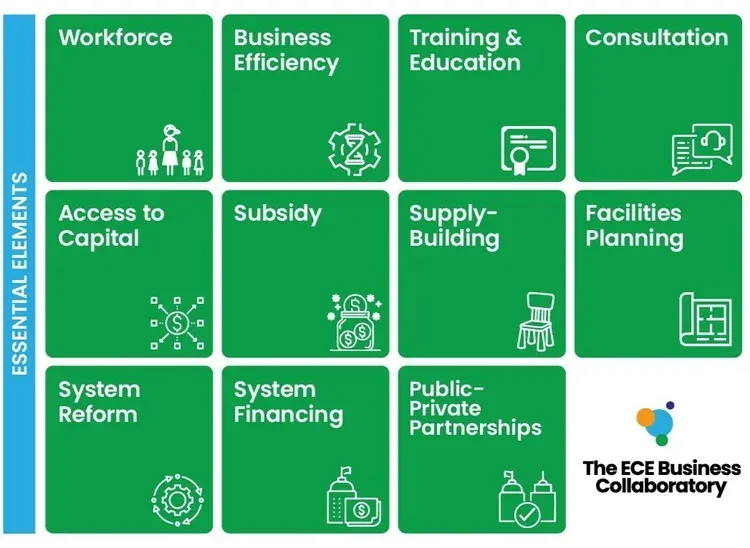
The Collaboratory is built around the Child Care Business Ecosystem (pictured above), it serves as both an assessment and a planning tool for the Collaboratory process, promoting innovation and flexibility to meet local needs.

Mapping
“Mapping has highlighted for me the opportunities to think beyond the early learning system in terms of business and funding access”. -Collaboratory Member
The first phase of the Collaboratory is the mapping phase. Collaboratory teams gather to identify current programs and policies that align with child care business sustainability across each of the eleven Essential Elements. The figure below illustrates the frequency of strategies mapped across all fifteen 2020-2022 team maps. Workforce was the element with the largest number of strategies mapped when aggregated across all maps. Conversely, Systems Financing and Consultation were the elements with the smallest number of strategies mapped. Once teams are able to lay out all the strategies they have in each Essential Element, they can move forward with the analysis phase.

Analysis
“It [the analysis stage] has shined a bright light on the areas we need to think about. It illuminated the issues I have always known we have had, and we are now able to tackle this in a more concrete way.”-Collaboratory Member
The second phase of the Collaboratory is the analysis phase. From here, teams are able to better understand which Essential Elements required additional coordination and strengthening. For teams, this is an important time to reflect on the robustness of their current programs and policies identified in the mapping stage. After analysis, teams are able to move to the next stage and develop plans to target their efforts. The figure below illustrates the most and least robust Essential Elements as identified by previous teams.

Planning
“Many of the efforts we mapped had the potential to improve our system; however, we tended to take a project-objective approach rather than a systems-improvement approach.”-Collaboratory Member
The third phase of the Collaboratory is the planning phase. Collaboratory teams gather to develop action plan strategies to improve the quality of resources, programs, and policies that align with child care business sustainability. Teams work to identify action plan strategies, funding, and metrics, and plan additional details focused on implementing their work. The figure below illustrates action plan strategies from previous cohorts, with teams having the most Ecosystem Element strategies in the darker-shaded images.
Collaboratory Convening
The Convening is an annual event that brings together Collaboratory teams to learn ECE best practices, share knowledge, and build relationships.

“Overall, I thought the Convening was unbelievable. It was the first time I attended an ECE event where everyone was focused on financing and providing business-related resources. In addition, having Jerry, the President & Chief Executive Officer, to be available throughout the Convening was a big plus.”
— - Collaboratory Member